
 By Erick
 I was born in 1990. I grew up in the Information Age. I think we are still in the Information Age, but we may be getting into the World Gone Crazy AI age.
And internet is more essential than ever. It is not yet a fundamental human right (and probably will never be) but is now a fundamental requirement in all households. Everything from making a payment to making a 5000-word end of semester thesis requires the internet.
But what would happen if the infrastructure carrying this internet is fragile? Exactly what’s happening now…. because the internet’s global infrastructure is indeed fragile. It’s literally a bunch of cables lying on the ocean floor, that are extremely easy to damage and extremely difficult to repair.
The Subsea Cable
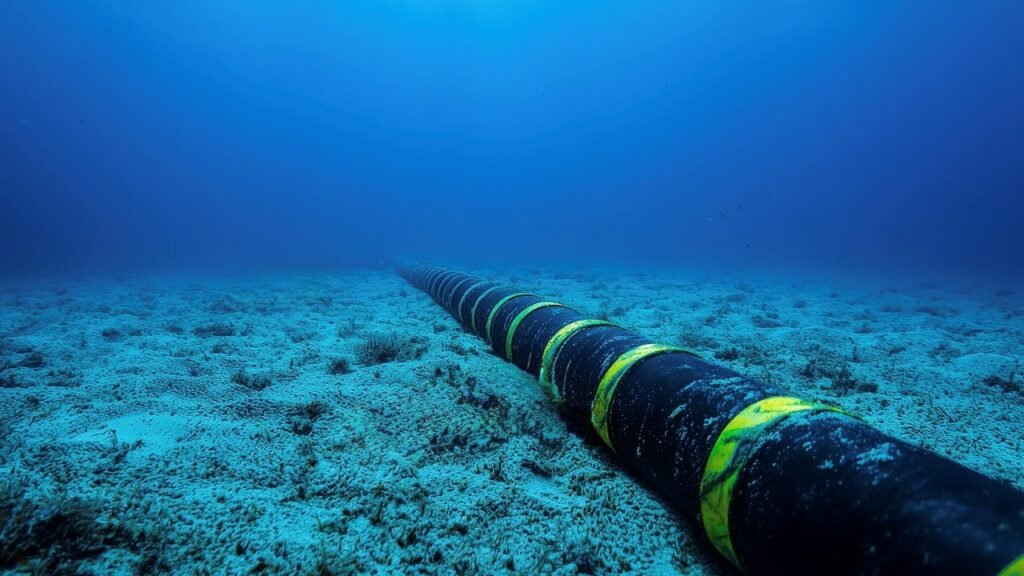
The success and functionality of the internet relies on it being global – across countries and continents. And 99% of intercontinental data traffic is transmitted via subsea cables. These are fibre-optic, high-capacity cables laid on the ocean floor. They are the backbone of the global internet.
Just think of this – without the “global” aspect of the internet, there would be no Google. Not outside the US atleast. These cables transmit information via light signals at nearly the speed of light (which satellites still can’t do), enabling instant international communication, cloud computing, and web browsing.
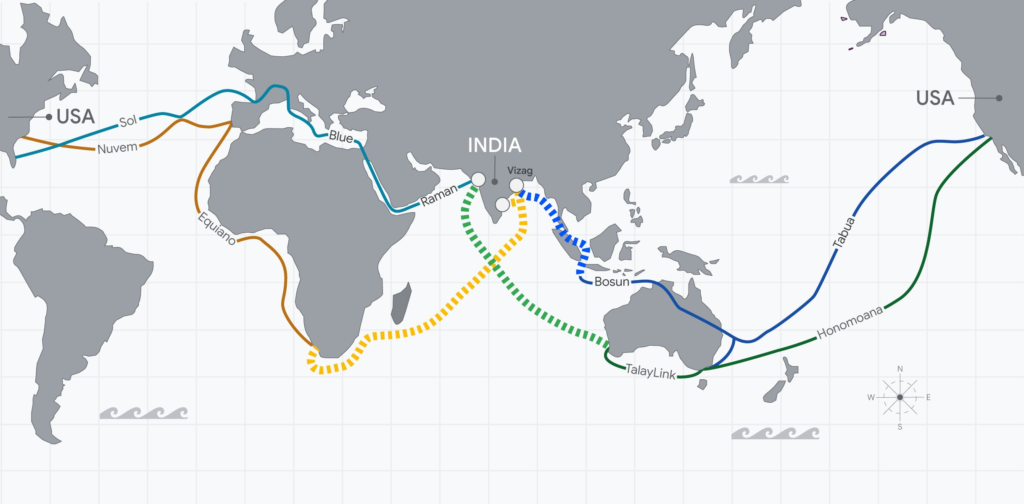
So when Google and Meta announce their massive fibre cable projects (Google did at the India AI Impact Summit), they are basically making the global internet more inter-connected. And making internet more reliable allows them to sell more, of course.
Why They Are Fragile
Well first of all, they are laid bare on the ocean floor. They are laid by specialized ships. Yes, the cables have an insulated coating. But deep-sea cables are generally only about as thick as a garden hosepipe, and thy house tiny fiber-optic strands protected by insulation and steel wire.
A ship anchor falling on the cable – even though the fall is softened by the water – is enough to damage the cable. For some cables, a fishing net is enough to damage the cable. Let alone a full aircraft carrier sinking to the ocean floor.
Damage to a single cable – depending on which terminals it connects – is enough to reduce internet capacity of an entire region.
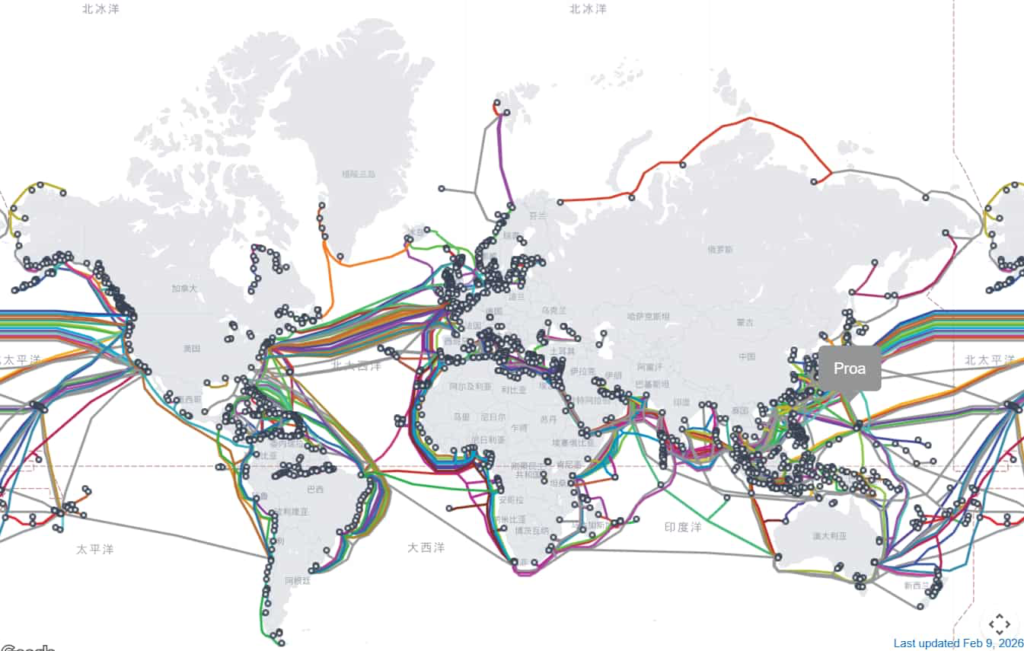
As of now, there are over 500 active cables worldwide, totaling nearly 1 million miles in length—enough to wrap around the Earth roughly 40 times. It is said about 100 – 150 cables are damaged annually. And once they are damaged, only specialized vessels can be deployed to repair them. And there aren’t many.
The Cable Repair Process
When a cable is severed thousands of feet below, the repair happens on a specialized ship rather than on the ocean floor. The whole repair process involves five steps.
- Detection: Engineers pinpoint the fault by sending light pulses (OTDR) or electrical signals down the line and measuring how far they travel before reflecting off the break.
- Retrieval: In deep water, a ship deploys a grapnel (a heavy hook) to snag the cable. The ship may intentionally cut the cable to pull up two separate ends.
- Onboard Splicing: Technicians bring the ends into a sterile “jointing room” on the ship. They use microscopes to align and fuse the hair-thin glass fibers using an electric arc.
- The “Final Splice”: Because a piece of cable was removed, a new “spare” section is added to bridge the gap. This extra length creates a “bight” (a loop) that is carefully lowered back to the seabed in an omega or hairpin pattern.
- Reburial: In shallower areas, Remotely Operated Vehicles (ROVs) use high-pressure water jets to carve a trench and rebury the cable to protect it from future anchor or fishing damage.
My Family Thanks A Subsea Cable Somewhere
Especially in times like this. I am an NRI living and working in Qatar. Three days before my writing this post, the US and Israel attacked Iran and it sparked a regional conflict, with missiles flying over our heads from one country to another. Of course, my parents sitting in Mumbai would be worried and I make it a point to video-call them atleast twice a day to tell them I’m well.
Imagine, if there were no subsea cables, would I be able to do that? Yes I could place a phone call, but that’s just not the same as seeing my face. For a parent, it makes a big difference. It lets my mom tell me I need a haircut or that I am sleeping too less…. and be more assured that I’m safe.
But Who Owns These Cables?
For decades, cables were owned by consortiums of state-owned telecom companies (like AT&T or Orange in the US). Today, “hyperscalers” like Google, Meta, Amazon, and Microsoftare taking over.
Big Tech’s share of international cable capacity has exploded from less than 10% in 2012 to over 70% today. Companies like Google and Meta now fund solely-owned private cables (e.g., Google’s Equiano and Meta’s 2Africa) to bypass traditional telecom bottlenecks and lower costs.
The shift is driven by the massive data demands of (you guessed it) AI training, real-time recommendations, and cloud services, which require high-throughput, low-latency highways.
This is the latest version of the global subsea cable map I could find. Enjoy!
Atleast once in my life, I want to be on the ship that either lays or repairs subsea cables. I hope the cables are here to stay, because satellite internet just doesn’t…. fly.