
 By Erick
 Many India-born tech companies shift their headquarters abroad for very practical reasons like regulation, capital, and customer proximity, even though the emotional cost for Indian users is real.
Let’s stay informed. Like I always say.
The emotional gap: Indian companies, foreign HQs
A lot of these brands feel deeply “Indian” because the founders, teams, and even the story are rooted here.
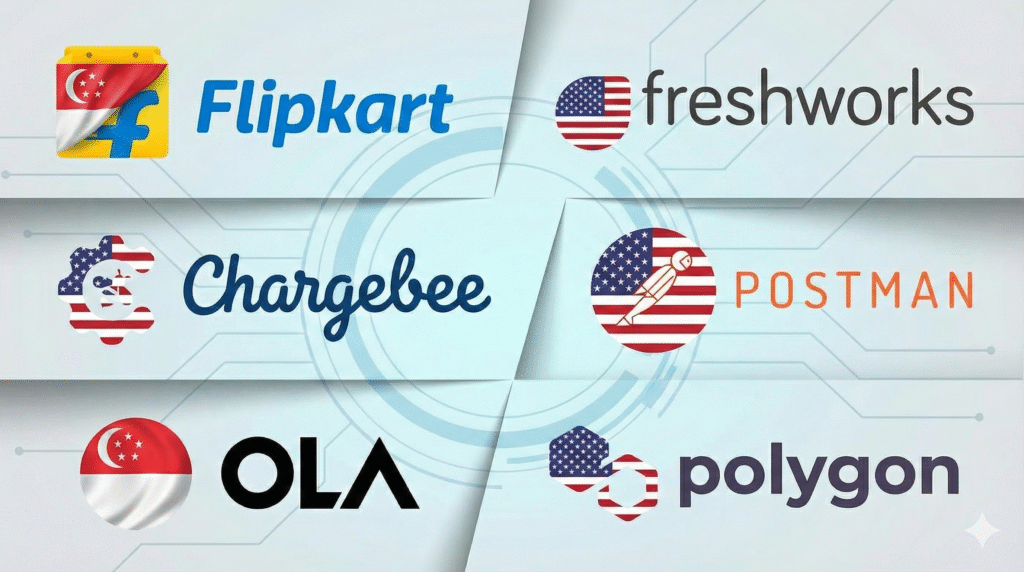
But on paper, the holding company often sits in the US or Singapore, which is what shows up in filings, IPO documents, and global databases. And is obviously not widely advertised by these companies.
That disconnect is why discovering Flipkart’s Singapore registration, or Freshworks’ Bay Area HQ, can feel like a betrayal even though most engineers and operations are still in India.
Freshworks – US listing and SaaS playbook
Key facts
- Founded in Chennai by Girish Mathrubootham and Shan Krishnasamy in 2010.
- Reincorporated and headquartered in San Mateo, California; listed on Nasdaq in 2021, raising about 1–1.03 billion dollars at a roughly 10–12 billion dollar valuation.
Why US HQ & Nasdaq? (mapped reasons)
- Freshworks sells SaaS tools mainly to US and European SMBs and enterprises, so being in the US puts sales, marketing, and leadership next to its biggest customers.
- A US holding company made it simpler to tap deep US public markets via Nasdaq, attract late-stage capital, and offer globally competitive ESOPs.
- India remained the engineering and support backbone; Nasdaq filings and media reports still highlight the Chennai roots even while calling it a US-based company.
Flipkart – Singapore structure and now a “homecoming”
Key facts
- Started in India in 2007 by Sachin and Binny Bansal; built from Bengaluru as a pure India story.
- Flipkart’s main holding entity was moved to/registered in Singapore around 2011; Walmart later acquired a majority stake through that Singapore structure.
Why Singapore HQ? (mapped reasons)
- India’s FDI rules in e‑commerce were restrictive and complex, while Singapore offered simpler regulations and clearer rules for foreign capital.
- Singapore had lower corporate tax, no capital controls on currency flows, and a large pool of VCs comfortable investing via a Singapore holdco.
- That structure made it easier to raise billions of dollars, do secondary transactions, and execute the Walmart deal.
Now: moving back towards India
- As Indian markets, rules, and IPO appetite matured, Flipkart has explored or started shifting parts of the structure back to India ahead of a possible domestic listing.
Postman – “build in India, sell to the world”
Key facts
- Originated in Bengaluru as a side project by Abhinav Asthana; incorporated as a company in 2014, serving developers globally.
- Later set up a strong presence and corporate base in San Francisco, while keeping a big India engineering office.
Why lean US for HQ? (mapped reasons)
- The most valuable customers and community (developers, product teams, and enterprise buyers) were in the US and Europe, so it made sense to put GTM and leadership in San Francisco.
- A US entity simplified raising large growth rounds from global VCs and gave Postman a “global-first” perception, critical in devtools.
- Postman stayed vocal about proving “great products can be built out of India” even as it adopted the classic cross‑border structure.
How reasons map across multiple companies
Table: Companies and reasons for offshore HQ
| Company | HQ on paper | India roots & presence | Main mapped reasons for HQ move/structure |
|---|---|---|---|
| Freshworks | San Mateo, USA (Nasdaq: FRSH) | Founded in Chennai, large Chennai/Bengaluru teams | US customers, US IPO route, global ESOPs, SaaS playbook |
| Flipkart | Singapore holding (Bengaluru ops) | India-founded ecommerce, India-only business | FDI constraints, tax, easier VC capital and M&A via Singapore |
| Postman | San Francisco, USA (private) | Product built in Bengaluru, big India engineering | Developer and enterprise customers in US/EU, global fundraising, brand perception |
| Chargebee | US-incorporated, Chennai hub | India-born SaaS, core product built in Chennai | Sell to US SaaS buyers, easier US contracts, investor comfort with US entities |
| BrowserStack | US entity with Mumbai core | Founded in Mumbai, large India engineering | Global devtools market, cross-border SaaS GTM, dollar billing |
| Polygon | Cayman/Singapore style holdco | Indian founders, India-heavy dev ecosystem | Crypto‑friendly jurisdictions, regulatory clarity, global token investors |
| Ola | Singapore holding, India ops | Indian founders, India-first mobility and EV | Capital, flexibility for foreign investors, structural workarounds around Indian rules |
(For some, the exact legal structure is multi‑layered, but the pattern is consistent: offshore holdco, India operating subsidiaries.)
The bigger pattern: India as the engine, not the address
- Cross‑border SaaS stories like Freshworks and Postman are often described as “India‑born, US‑focused” because engineering and early product work happen here, but revenue and listings are abroad.
- Commentaries on Flipkart, Ola, and others show the same logic in consumer tech: Singapore or other hubs for capital and regulation, India for the actual market and teams.
From an Indian user’s perspective, it can feel like “our” success is being booked under another flag.
From a founder’s perspective, these choices are often framed as survival and scale hacks rather than patriotism tests: go where capital and customers are, while still betting big on India for talent and growth.
Does this hit you as much as it hit me?